What is NOCSAE?
- NOCSAE stands for National Operating Committee on Standards for Athletic Equipment
- NOCSAE is an independent, non-profit organization that establishes safety standards for athletic equipment using science-based performance testing. NOCSAE standards are set in accordance with ANSI/ISO 17065 international guidelines.
- Products are then tested by an independent third-party named SEI, which specializes in personal protective equipment.
- NOCSAE standards, testing methods, and procedures can be found here.
What is ASTM?
- ASTM International is a not-for-profit global leader in the development and delivery of voluntary consensus standards.
- Its standards are created by more than 30,000 volunteers from 150 different countries.
- ASTM standards for lacrosse equipment can be found here.
- Products are then tested by an independent third-party named SEI, which specializes in personal protective equipment.
How do I know if my equipment meets the required standard?
- Check the SEI website, which lists all certified products.
- Look for a certification mark on the product itself — applied as a sticker, printed on, or molded into the equipment
- Check the original product packaging, which typically displays the relevant certification mark
- Examples of what to look for are as follows:
Helmets
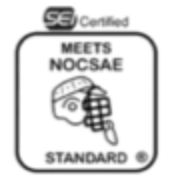
Goggles

Shoulder Pads/Goalkeeper Chest Protector
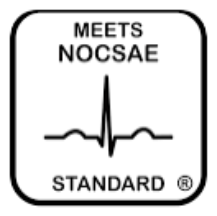
Shoulder Pads/Goalkeeper Chest Protector
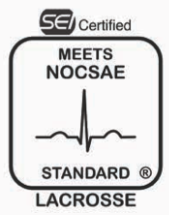
Women’s Headgear

Certified ASTM F3137-15A ASTM F3077-21
Can I use my existing equipment?
- Yes, provided it carries the certification markings shown above and/or appears on the SEI website.
Why is women’s headgear certified to an ASTM standard rather than NOCSAE?
- The ASTM standard addresses risks specific to the women’s game and accommodates the sport’s unique dynamics, where intentional contact is prohibited.
- The NOCSAE standard — designed for hard-shell helmets in collision sports — is not appropriate for the women’s game. The ASTM standard specifically allows for flexible, soft-shell headgear.
Why is protective eyewear being required?
- Shot velocities in the women’s game continue to rise — driven by improved stick and stringing technology, increased athleticism and refined coaching. One of the world’s top women’s players has been recorded with a shot velocity of 95 mph.
- While the rules of the game are designed to prevent the ball or crosse from striking players, contact does still occur.
- Research indicates that wearing protective eyewear reduces the likelihood of injury to the eye and surrounding area by up to 84 percent when impact occurs.
Why is headgear now permitted in the women’s game?
- A large epidemiological study covering more than one million athletic exposures across men’s and women’s high school and collegiate lacrosse found that women’s lacrosse, despite being a non-contact sport, had a higher rate of head, face and eye injuries than the men’s game, with 40 percent of those injuries identified as concussions.
- Stick or ball contact is the primary mechanism of head injury in the women’s game. A 2024 study found a 50 percent reduction in concussion rates among women’s lacrosse athletes wearing soft-shell headgear.
- There is no safety concern for athletes who choose not to wear headgear when competing alongside or against those who do. The approved headgear standard is specifically designed to limit risk to all players on the field.
Why must helmets meet a certified standard?
- Epidemiological data from U.S. high school and collegiate lacrosse consistently rank concussions among the top three most common injuries in the men’s game. Catastrophic head injuries, while rare, have been documented and carry lifelong or fatal consequences.
- Helmets meeting NOCSAE or comparable standards have been scientifically validated and widely adopted in domestic leagues, and are demonstrated to reduce the risk of severe head and facial injuries.
- Establishing this requirement at the international level ensures consistent protection for all athletes and upholds the duty of care owed by governing bodies to participants in the sport.
Why must shoulder pads and goalkeeper chest protectors meet a NOCSAE standard, including commotio cordis protection?
- Before the development of performance standards, most commercially available shoulder pads and chest protectors were designed to prevent bruising and not to protect against commotio cordis.
- Laboratory studies simulating ball impacts demonstrated that older protectors did not reliably reduce the risk of ventricular fibrillation. NOCSAE-certified equipment is engineered specifically to address this risk.
What is commotio cordis?
- Commotio cordis is sudden cardiac arrest caused by a direct, non-penetrating blow to the chest, such as that from a lacrosse ball, that interrupts the heart’s electrical rhythm. It can occur from impacts at speeds between 30 and 50 mph.
- Treatment requires immediate activation of Emergency Medical Services, cardiopulmonary resuscitation (CPR), and the use of an automated external defibrillator (AED).
- An estimated 15 to 25 athletes across all sports die from commotio cordis each year.
Why aren’t women in field lacrosse or sixes lacrosse required to wear commotio cordis protection?
- Current research indicates that women are not at the same risk as men with respect to commotio cordis.
- A retrospective injury surveillance study covering 1982 to 2023 recorded four incidents and one death among female athletes across all sports, compared with 60 incidents and 33 deaths among male athletes. None of the four female cases were attributed to participation in lacrosse.
Where will these requirements apply?
- The requirements apply at all World Lacrosse owned and sanctioned events, including World Championships, Continental Qualifiers and any World Lacrosse-managed multi-sport competitions such as The World Games and the Olympic Games.
- Members are strongly encouraged to adopt these equipment rules for domestic play.
How will compliance with these requirements be enforced?
- At each pre-game meeting, an official will ask each head coach: “Coach, do you certify that your players are properly equipped by rule, including the use of certified equipment?” The head coach must verify and confirm. Coaches are responsible for ensuring their athletes understand and comply with these rules, as with all other rules of the sport.
- No athlete will knowingly be permitted on the field of play unless properly equipped.
- If an official identifies a non-compliant athlete during play, that athlete will be removed from the field of play and may not return until properly equipped.
Can World Lacrosse help members acquire certified equipment?
- Yes. Members can apply for assistance through World Lacrosse grants and other planned programs and are encouraged to contact the Sport Department to discuss their needs.
- Additional equipment procurement opportunities will be announced in the coming months.
How will the new requirements be incorporated into the WL playing rules?
- Sixes: Rules will be updated and re-posted to the WL website in the coming weeks (Version 2.0).
- Men’s field: Requirements will be incorporated into the 2028–2031 Men’s Field Rulebook.
- Women’s field: Requirements will be incorporated into the 2027–2030 Women’s Field Rulebook, currently under revision.
- Box: Rules will be updated and re-posted to the WL website in the coming weeks (Version 2.0).
When must athletes be in compliance?
- Sixes – Beginning with the 2027 WL Sixes Championships and all WL-owned or WL sanctioned events thereafter.
- Box Lacrosse – Beginning with the 2028 WL Box Championships and all WL-owned or sanctioned events thereafter.
- Women’s Field – Beginning with the 2029 WL Women’s U20 Championship. If a continental federation holds its qualifier for the 2030 WL Women’s Championship before then, athletes within that federation must comply at the qualifier and in all subsequent WL-sanctioned events.
- Men’s Field – Beginning with the 2029 WL Men’s U20 Championship. If a continental federation holds its qualifier for the 2031 WL Men’s Championship before then, athletes within that federation must comply at the qualifier and in all subsequent WL-sanctioned events.
- This delayed implementation timeline was designed to allow athletes ample time to source and become accustomed to any replacement equipment that may be necessary.
Why was this approved by the Board rather than by a member vote?
- The World Lacrosse Board of Directors has a duty of care to the sport, its athletes and the organization.
- Following review of the relevant research, established industry standards and stakeholder consultation, action was determined to be necessary.
- Under World Lacrosse Bylaws (Article 1.4.7.6), the Board is authorized to approve changes to playing rules and equipment specifications when those changes are measurable or impact athlete safety. Each of the changes adopted is supported by research-based empirical evidence demonstrating a measurable positive impact on athlete safety.